
How to Choose the Best Power Bank Capacity
How to Choose the Best Power Bank Capacity


Stop Buying the Wrong Power Bank
Have you ever bought a power bank that barely charged your phone once? Or carried a heavy brick that you never really needed? You’re not alone. Most people pick a power bank based only on big numbers printed on the box — and end up wasting money.
The truth is: choosing the right capacity isn’t about buying the biggest option. It’s about matching capacity to your real needs.
In this complete guide on How to Choose the Best Power Bank Capacity, you’ll learn:
-
What mAh really means
-
How many charges different devices need
-
How to calculate your ideal capacity
-
Which size is best for phones, travel, and laptops
By the end, you’ll never again wonder what power bank capacity do I need or how many mAh power bank should I buy.
What Does mAh Mean in Power Banks?
Before choosing correctly, you need power bank capacity explained in simple terms.
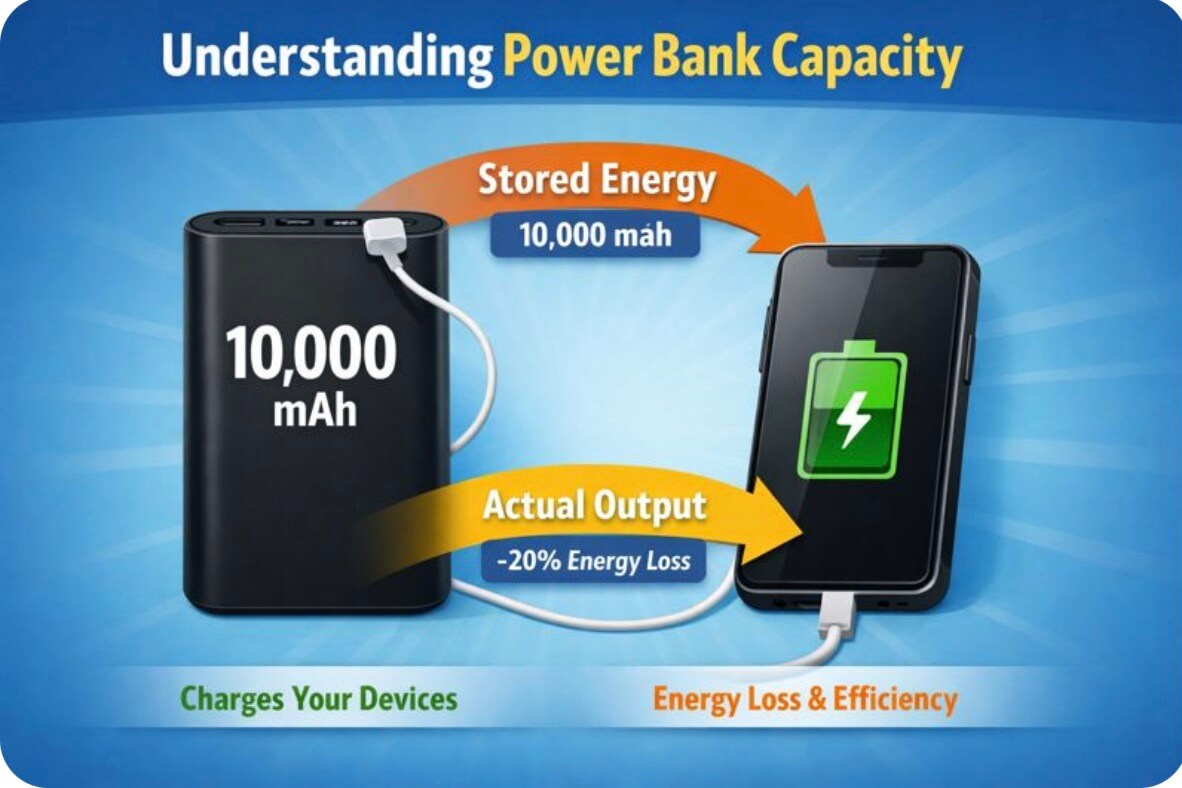
mAh (milliampere-hour) measures how much electrical charge a battery can store.
Higher mAh = more stored energy = more device recharges.
But here’s the catch:
Higher mAh ≠ always better.
Why?
-
Larger mAh = heavier power bank
-
Higher cost
-
Airline flight restrictions
-
Diminishing returns due to energy loss
A good mAh guide power bank rule:
Only buy as much capacity as your real usage needs.
Understanding power bank capacity explained properly helps avoid overpaying or underbuying.
How Much Capacity Do Common Devices Need?


To answer what power bank capacity do I need, compare your device battery to typical power bank output.
Average Device Battery Sizes

| Device | Battery Size (mAh) | Charges from 10,000mAh Power Bank* |
|---|---|---|
| iPhone 15 | ~3,350 mAh | ~2.5 charges |
| Samsung Galaxy S24 | ~4,000 mAh | ~2 charges |
| Google Pixel 8 | ~4,575 mAh | ~1.8 charges |
| iPad Mini | ~5,100 mAh | ~1.5 charges |
| MacBook Air M2 | ~5,000–6,000 mAh equivalent | ~1 charge (with PD output) |
*Accounting for ~20% energy loss.
So if you’re asking how many mAh power bank should I buy, it depends on:
-
Your device battery
-
How many recharges you want
-
Whether you travel often
This table is the foundation of power bank capacity explained simply.
How to Calculate the Right Power Bank Capacity
Now let’s make this practical.
If you’ve ever wondered what power bank capacity do I need, follow this easy formula.
Step-by-step calculation
-
Check your device battery size
Example: iPhone 15 = 3,350 mAh -
Multiply by number of charges you want
Want 3 full charges?
3,350 × 3 = 10,050 mAh -
Add 20% energy loss
10,050 × 1.2 = ~12,000 mAh
👉 You’d need a ~13,000–20,000 mAh power bank.
This method also answers how many mAh power bank should I buy with real math — not guesswork.
It’s the core of any good mAh guide power bank strategy.


Best Power Bank Capacities for Different Uses
Choosing the best power bank capacity for phone or laptop depends on lifestyle.
Let’s break it down.
For Daily Phone Use → 5,000–10,000 mAh
Perfect if you:
-
Commute daily
-
Need 1–2 extra charges
-
Want something lightweight
Example:
A 10,000 mAh bank gives an iPhone 15 about 2–3 full charges.
This is usually the best power bank capacity for phone users who charge nightly at home.
For Travel → 20,000 mAh
Best if you:
-
Travel long hours
-
Don’t always have outlets
-
Charge phone + earbuds + tablet
A 20,000 mAh unit:
-
Charges an iPhone ~5 times
-
Charges an iPad ~3 times
If you’re asking what power bank capacity do I need for trips — this is the sweet spot.
For Laptops → 25,000+ mAh with Power Delivery (PD)
Necessary if you:
-
Use MacBook, Surface, or Chromebook
-
Work remotely
-
Need USB-C PD output
A 30,000 mAh PD power bank can:
-
Fully charge a MacBook Air once
-
Still recharge your phone twice
Here how many mAh power bank should I buy depends on laptop wattage — but 25,000+ is ideal.
Real Device Examples
Let’s apply this power bank capacity explained logic to real-world cases.
Example 1: Student with iPhone 15
-
Phone battery: 3,350 mAh
-
Wants 2 charges per day
-
Calculation: 3,350 × 2 × 1.2 ≈ 8,000 mAh
Answer: Buy a 10,000 mAh unit → best power bank capacity for phone daily use.
Example 2: Traveler with Samsung S24 + earbuds
-
Phone: 4,000 mAh
-
Earbuds: 500 mAh
-
Needs 3 days backup
Total ≈ 15,000–18,000 mAh → Buy 20,000 mAh.
Now you know what power bank capacity do I need for travel.
Example 3: Remote worker with MacBook Air
-
Laptop: ~5,500 mAh equivalent
-
Needs 1 full charge + phone top-ups
Total ≈ 20,000–25,000 mAh → Buy 30,000 mAh PD.
Clear answer to how many mAh power bank should I buy for work.
Common Mistakes When Choosing Power Bank Capacity
Avoid these frequent errors:
-
Buying huge capacity “just in case”
-
Ignoring airline 27,000 mAh flight limit
-
Forgetting energy loss
-
Choosing no PD for laptops
-
Ignoring weight and portability
Understanding power bank capacity explained prevents these mistakes.
Quick Buying Checklist
Before buying, ask yourself:
-
What devices am I charging?
-
How many charges do I need per day?
-
Do I travel often?
-
Do I need laptop charging (PD)?
-
Do I want pocket-size or backpack-size?
Answering these removes confusion about what power bank capacity do I need.
Recommended Reading
For deeper product picks:
-
Best iPhone power banks tested:
https://bestmobileessentials.com/best-power-banks-for-iphone-15-tested-2026/ -
Best budget power banks for students:
https://bestmobileessentials.com/best-budget-power-bank-for-students/
These help match best power bank capacity for phone with real product recommendations.
FAQs
1) How to choose power bank capacity?
Use this rule:
Device battery × desired charges × 1.2 (energy loss).
This formula answers how many mAh power bank should I buy precisely.
2) Which is better: 10,000 mAh or 20,000 mAh power bank?
-
10,000 mAh → lighter, daily use
-
20,000 mAh → travel, multiple devices
Pick based on what power bank capacity do I need for your routine.
3) Is 30,000 mAh better than 10,000 mAh?
Only if you:
-
Charge laptops
-
Travel long periods
Otherwise, it’s heavier than needed. That’s why power bank capacity explained matters.
4) Should I get a 5,000 or 10,000 mAh power bank?
-
5,000 mAh → emergency top-up
-
10,000 mAh → full daily backup
For most users, 10,000 mAh is the best power bank capacity for phone.
5) How to choose the best power bank capacity for iPhone?
Check iPhone battery (~3,000–4,000 mAh).
Multiply by desired charges.
Most users need 10,000–20,000 mAh.
That’s How to Choose the Best Power Bank Capacity for iPhone correctly.
Flight Rules – Power Bank Capacity for Air Travel
Airlines typically allow:
-
Up to 27,000 mAh (100Wh) in carry-on
-
No power banks in checked baggage
So if you’re asking what power bank capacity do I need for flights, choose ≤ 20,000 mAh to stay safe.
Why This mAh Guide Matters
A proper mAh guide power bank approach:
-
Saves money
-
Avoids unnecessary weight
-
Ensures enough backup
-
Extends battery lifespan
That’s why learning How to Choose the Best Power Bank Capacity properly makes a real difference.
Quick Summary
Let’s recap:
-
mAh = stored energy
-
Bigger isn’t always better
-
Calculate based on your device
-
Add 20% loss
-
Match capacity to lifestyle
This is the simplest power bank capacity explained guide you’ll need.
Conclusion — Make a Smart Buying Decision
Choosing the right power bank isn’t guesswork anymore.
Now you know:
-
What power bank capacity do I need
-
How many mAh power bank should I buy
-
The best power bank capacity for phone
-
How power bank capacity explained really works
-
How to use a mAh guide power bank approach
Follow this guide, and you’ll always pick the perfect model.
This is How to Choose the Best Power Bank Capacity the smart way.
Author Box
Written by: Mobile Essentials Tech Team
We test and review power banks, chargers, and mobile accessories to help users make smarter buying decisions. Our guides are based on real-world device testing, battery efficiency data, and travel usage scenarios.
Sources & References
-
USB Power Delivery Specifications (USB-IF.org)
-
Typical smartphone battery capacities from Apple, Samsung, Google official specs
-
Airline lithium battery carry-on limits (IATA guidelines)
-
Battery energy conversion loss averages (20–30%) from consumer electronics testing standards
Final Note
You now have the complete framework for How to Choose the Best Power Bank Capacity — practical, simple, and buyer-proof.