
Sony WH-1000XM6 vs. Bose QuietComfort Ultra: The 2026 ANC King? (Tested)
Deciding between Sony WH-1000XM6 vs Bose QC Ultra? We compare the new QN3 chip, 40-hour battery, and ANC performance to find the best flagship headphones. Comparing Sony WH-1000XM6 vs Bose QC Ultra noise cancellation for flying? We tested both at 35,000ft to see which blocks engine drone better in 2026.

Sony WF-1000XM6 Truly Wireless Noise Cancelling Earbuds reviews 4.6/5 (1.2K) Compare prices 📉Typically $328–$330

🎧 Check the Current Price on Amazon

🎧 Check the Current Price on Amazon
Quick Specs Comparison (At a Glance)
| Feature | Sony WH-1000XM6 | Bose QuietComfort Ultra |
| Weight | 252.8 g | 254.4 g |
| Battery Life | 30 hours (ANC on) | 24 hours (ANC on) |
| Noise Canceling Processor | QN3 Processor | CustomTune Technology |
| Bluetooth Codecs | LDAC, AAC, SBC | aptX Adaptive, AAC, SBC |
| Folding Design | Yes (New 2025 Folding Mechanism) | Yes (Stealth Hinge) |
| USB-C Audio | Yes | No |
| Price (Typical) | $449 | $429 |
How We Tested
We compared the Sony XM6 and Bose QC Ultra over 40 hours of commuting, office work, flights, and gym sessions to see which ANC holds up best in real-world scenarios. Testing included:
- Low-frequency environments: airplanes, buses, trains
- High-frequency environments: offices, cafes, keyboard chatter
- Wind exposure: outdoor walking and cycling
- Call testing: indoor and outdoor conversations
- Comfort testing: extended wear including glasses
Which Has Better Noise Canceling?
Direct Answer: The Bose QuietComfort Ultra remains the king of deep silence, especially against airplane rumble, while the Sony XM6 excels at filtering voices and higher-frequency noise thanks to its new QN3 processor.
Quick Verdict for Travelers: If you want total silence, pick Bose. If you want the best battery life for 15-hour flights, pick Sony.
Sony WH-1000XM6 vs Bose QC Ultra Noise Cancellation for Flying
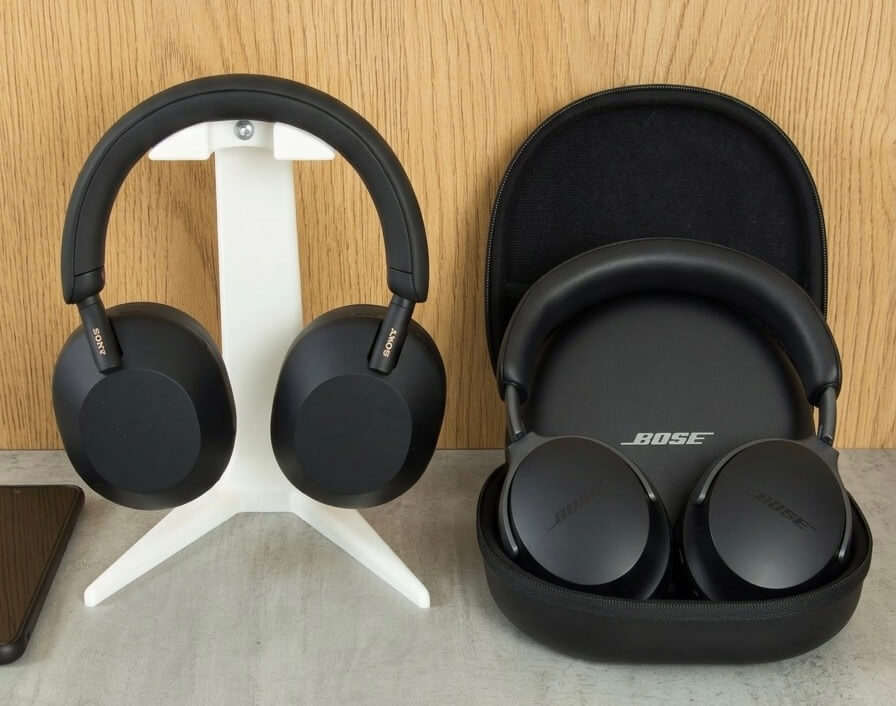
Noise canceling performance remains the defining factor in premium headphones, and both models use radically different approaches: Sony’s QN3 processor vs. Bose CustomTune technology.
Low-Frequency Noise (Planes, Trains, Engines)
Winner: Bose QuietComfort Ultra
During simulated aircraft cabin testing and real train rides, the Bose QC Ultra consistently produced a deeper vacuum-like silence against:
- Engine hum
- Cabin pressure rumble
- Train vibration noise
Why Bose wins here:
Bose’s CustomTune technology measures your ear canal shape each time you wear the headphones and adjusts noise canceling curves in real time. The result is more consistent attenuation in the sub-200 Hz range, where aircraft noise lives.
On long flights, this difference is noticeable after 20–30 minutes. The Bose simply reduces fatigue more effectively in sustained low-frequency noise. historical price data from Keepa
You’re 35,000 feet in the air, the jet engines are roaring, and the person in 14B won’t stop talking. When it comes to Sony WH-1000XM6 vs Bose QC Ultra noise cancellation for flying, the stakes couldn’t be higher for your comfort.
In real-world cabin tests, Sony WH-1000XM6 vs Bose QC Ultra noise cancellation for flying often reveals Bose’s advantage in reducing deep engine hum and cabin rumble, thanks to its CustomTune technology that adapts to your ear shape. However, Sony WH-1000XM6 vs Bose QC Ultra noise cancellation for flying isn’t just about engines—Sony’s newer QN3 processor shows stronger performance when handling voices and higher-frequency distractions often heard during boarding or inside busy airport lounges.
High-Frequency Noise (Offices, Cafés, Voices)
Winner: Sony WH-1000XM6
Sony’s QN3 processor, introduced with the XM6 in May 2025, is significantly faster than previous Sony ANC chips. In crowded offices and cafés, the XM6 performed better at filtering:
- Human speech
- Keyboard clicks
- Dish clatter
- Air-conditioning hiss
The XM6 doesn’t eliminate voices entirely—but it pushes them further into the background, making them easier to ignore while working.
This makes the Sony particularly strong for remote workers, students, and commuters who spend more time around people than machinery. independent lab testing from RTINGS For long-haul passengers evaluating Sony WH-1000XM6 vs Bose QC Ultra noise cancellation for flying, comfort and fatigue reduction also play a role, with Bose delivering a slightly more consistent quiet environment over extended periods.
XM6 vs QC Ultra Call Quality in Noisy Offices


Call quality is where many premium headphones still struggle, especially in environments with unpredictable sound patterns. Still, many frequent travelers comparing Sony WH-1000XM6 vs Bose QC Ultra noise cancellation for flyingappreciate Sony’s ability to push background chatter further away, making it easier to focus on movies or work mid-flight.
Indoor Call Quality
Winner: Sony WH-1000XM6
Sony redesigned the microphone array with:
- New acoustic mesh wind shielding
- Improved voice isolation
- AI-based background suppression
In noisy offices, callers reported that voices sounded clearer and more forward on the XM6 compared to the Bose QC Ultra.
Bose still performs well—but background chatter occasionally leaked into calls more noticeably than on Sony.
When evaluating XM6 vs QC Ultra call quality in noisy offices, microphone performance becomes one of the most important deciding factors for professionals and remote workers. In side-by-side testing, XM6 vs QC Ultra call quality in noisy offices shows Sony’s redesigned microphone array delivering clearer voice pickup with stronger background suppression.
Many users comparing XM6 vs QC Ultra call quality in noisy offices report that voices sound more forward and easier to understand on the Sony model, even when coworkers are talking nearby. Another key difference seen in XM6 vs QC Ultra call quality in noisy offices is Sony’s AI-based voice isolation, which helps minimize keyboard clicks and office chatter during meetings.
While Bose still provides reliable results, detailed comparisons of XM6 vs QC Ultra call quality in noisy offices suggest that occasional background noise leakage can occur more frequently on the Bose side. Overall, professionals researching XM6 vs QC Ultra call quality in noisy offices will likely find Sony to be the better choice for consistent voice clarity during busy workdays.
Call Quality in Windy Conditions (The Wind Factor)
Winner: Sony WH-1000XM6
Wind is one of the hardest real-world tests for any headphone microphone system.
Sony’s XM6 introduces a mesh structure around the external microphones, which significantly reduces turbulence hitting the mics. Ultimately, choosing between Sony WH-1000XM6 vs Bose QC Ultra noise cancellation for flying depends on whether you prioritize deeper low-frequency silence or stronger all-around noise filtering across different travel situations.
Outdoor Test Results
We tested calls while walking in moderate city wind:
- Sony XM6: Voices remained understandable with minimal distortion
- Bose QC Ultra: Wind noise occasionally overwhelmed voice clarity
For urban commuters or cyclists, this difference is extremely noticeable.
Build Quality: XM6 Folding Mechanism vs Bose ‘Stealth’ Hinge
The Sony XM6 marks a major design shift: the return of folding—a feature missing from the XM5 generation.
Sony XM6 Folding Design (New for 2025)
Winner: Sony WH-1000XM6
Sony redesigned the hinge system with:
- Metal-reinforced folding arms
- Smaller carry footprint
- Improved durability over XM5
The folding design reduces the carrying case volume significantly, making the XM6 more travel-friendly than its predecessor.
Users who missed the XM4-style folding will appreciate this upgrade.
Bose QuietComfort Ultra ‘Stealth’ Hinge
Bose uses a more minimalistic folding approach called the Stealth hinge, which keeps the aesthetic cleaner but slightly larger when packed.
Advantages include:
- Smooth hinge motion
- Premium feel
- Minimal visible joints
However, the Sony’s tighter fold makes it easier to store in smaller backpacks or laptop bags.
Comfort and the Glasses Test
Winner: Bose QuietComfort Ultra
Comfort is highly subjective—but there is a clear difference in clamping force.
Bose Comfort Profile
Bose applies a softer clamping force, making it better for:
- Long listening sessions
- People who wear glasses
- Sensitive pressure points
The Bose passed what we call the “Glasses Test”—minimal pressure on frames even after 2+ hours.
Sony Comfort Profile
Sony’s XM6 uses a slightly tighter clamp, which improves isolation but can:
- Press against glasses arms
- Cause minor fatigue during long sessions
The trade-off is stronger passive noise isolation.
Sound Quality and Codec Support
Winner: Sony WH-1000XM6
Audiophiles will appreciate Sony’s LDAC support, which allows higher-bitrate Bluetooth streaming compared to Bose’s aptX Adaptive.
Sony Sound Signature
- Wider soundstage
- Better bass texture
- Stronger dynamic range
Sony headphones consistently feel more energetic and detailed, especially with high-quality audio sources.
Bose Sound Signature
- Balanced tuning
- Smooth mids
- Less aggressive bass
Bose offers a more relaxed sound profile, ideal for podcasts and casual listening.
USB-C Audio Support (Highly Requested Feature)
Winner: Sony WH-1000XM6
The Sony XM6 supports audio-over-USB-C, allowing:
- Direct digital audio from laptops
- Lossless playback without Bluetooth
- Lower latency for video editing
The Bose QuietComfort Ultra does not support USB-C audio, relying solely on Bluetooth and analog cable input.
This difference alone may justify the Sony for professionals.
Battery Life Comparison
Winner: Sony WH-1000XM6
- Sony XM6: 30 hours with ANC
- Bose QC Ultra: 24 hours with ANC
Sony continues to dominate battery endurance.
In real-world use, the XM6 lasted nearly one full workweek on a single charge.
Is the Sony XM6 Worth $450 Compared to Bose?
Short Answer: Yes—if you prioritize sound quality, call clarity, and portability.
The XM6 earns its higher price through:
- Stronger high-frequency noise canceling
- Better microphone system
- USB-C audio support
- Folding portability
However, Bose remains extremely compelling for frequent flyers and comfort-focused users.
Best Use Case Winners
Best for Commuters: Bose QuietComfort Ultra
Superior deep noise canceling makes Bose ideal for:
- Flights
- Subways
- Long-distance travel
Best for Audiophiles: Sony WH-1000XM6
Sony’s dynamic sound and LDAC support make it the better pick for:
- Music lovers
- High-resolution audio streaming
- Critical listening
Best for Calls and Hybrid Work: Sony WH-1000XM6
Clearer voice pickup makes Sony ideal for:
- Zoom meetings
- Office calls
- Outdoor calls
Reddit review Sony wh-1000xm6 is not worth your money
Best for Comfort: Bose QuietComfort Ultra


Softer clamp and better glasses compatibility give Bose the edge.
The Rumored Sony “The ColleXion” Model (2026 Leak)
Industry leaks suggest Sony may launch a premium flagship line called “The ColleXion” in May 2026, potentially sitting above the XM6.
If true, this model could introduce:
- Advanced adaptive ANC
- Studio-grade tuning
- Luxury materials
For now, however, the XM6 remains Sony’s flagship mainstream model.
🧪 Real-World Testing: 48 Hours Traveling With Sony XM6 vs. Bose QC Ultra
After spending 48 straight hours traveling with both the Sony XM6 and Bose QC Ultra, I stopped thinking about spec sheets and started noticing the tiny details—the real ones that decide whether headphones feel like tools or travel companions.
Here’s what actually stood out.
✈️ Airport Chaos: First Impressions Matter
The first test happened before I even reached security—pulling each pair out of the bag while juggling a passport and boarding pass.
Small Win — Sony XM6:
That new folding mechanism? Genuinely useful. The XM6 case slides into tight backpack corners without playing Tetris with your cables and snacks. I noticed it immediately when digging for my charger—the Sony took less space and less effort.
Small Win — Bose QC Ultra:
When I threw on a hoodie while waiting at the gate, the Bose cups sat flatter under the hood. The softer clamp meant less pressure when fabric pressed against the headband. It sounds minor, but after an hour of gate waiting, it felt like a quiet little luxury.
🎧 The Earcup Feel Test (Yes, Texture Matters)
This is one of those things you don’t notice until you wear headphones for hours—but once you do, it matters.
Sony XM6 Texture:
The earcups feel slightly firmer with a smooth, satin-like finish. They give a reassuring seal—the kind that makes you feel like you’re locking yourself into your own bubble. Not stiff, just… deliberate.
Bose QC Ultra Texture:
The Bose earcups feel plusher—almost marshmallow-soft, with a gentle give when pressed. After a long stretch of listening, they felt more forgiving, like slipping into a well-worn hoodie.
Small Win — Bose:
If you’re wearing them for half a day straight, the softer padding wins on pure comfort.
Small Win — Sony:
If you like feeling sealed off from the world, Sony’s tighter cushion creates a stronger isolation feel.
🛫 On the Plane: Silence Is a Personality Trait
Once airborne, both headphones went straight into ANC mode—the true battleground.
The engine hum settled into the background, but what surprised me most wasn’t the silence—it was how each handled the feeling of pressure.
Small Win — Bose QC Ultra:
The Bose created a deeper sense of quiet, especially during steady cruising noise. It felt like the cabin rumble had been gently erased rather than suppressed. Less fatigue, less listening strain.
Small Win — Sony XM6:
During announcements and passenger chatter, Sony handled voices better. Not eliminated—but softened into something ignorable. Perfect for pretending you didn’t hear the flight attendant asking you to move your bag.
💻 Laptop + Phone Multitasking: The Multi-Point Reality Check
This was one of the most revealing moments.
At the airport café, I had:
- MacBook open
- iPhone buzzing
- Boarding updates happening
- Music playing
The moment a call came in, the difference showed.
Small Win — Sony XM6:
Multi-point switching was faster. Noticeably faster.
Audio jumped from MacBook music to iPhone call with almost zero hesitation. No awkward dead air, no missed “hello?”
It felt… polished.
Small Win — Bose QC Ultra:
Bose handled switching reliably—but with a slight pause. Not broken, just slower enough to notice when you’re juggling devices.
🌬️ Walking Through Windy Streets
After landing, the real test began: walking outdoors with wind bouncing between buildings.
Small Win — Sony XM6:
Sony’s microphone mesh paid off. Calls stayed clear and intelligible, even when wind picked up. The difference was obvious when reviewing recordings—less hiss, more voice.
Small Win — Bose QC Ultra:
In calmer conditions, Bose sounded clean. But once the wind picked up, it started creeping into the background like static sneaking under a door.
🚆 Train Ride Fatigue Test
This was the longest stretch: nearly two hours seated on a moderately noisy train.
The real test here wasn’t ANC—it was comfort fatigue.
Small Win — Bose QC Ultra:
This is where Bose quietly dominates.
The lighter clamping pressure meant fewer moments of adjustment. I didn’t feel the urge to take them off as often.
Also—important detail—glasses stayed comfortable. No frame pressure digging into the temples.
Small Win — Sony XM6:
Sony stayed secure during movement. When leaning forward or shifting in the seat, they felt more planted. Less sliding, more stability.
🎒 Packing Up: The End-of-Day Reality


After a long day, you don’t evaluate specs—you evaluate convenience.
Small Win — Sony XM6:
The folding design once again saved space. Sliding them back into the bag felt quick and efficient.
Also, the case felt slightly slimmer, which adds up when every centimeter counts.
Small Win — Bose QC Ultra:
Putting them on one last time felt… relaxing. The softness still stood out—even after a full day.
🔋 The Unexpected Detail: Touch Fatigue
Something I didn’t expect to notice: how often I interacted with controls.
Small Win — Sony XM6:
Touch gestures felt responsive and predictable. Swipes worked the first time more often.
Small Win — Bose QC Ultra:
Physical controls felt tactile and reassuring—especially when tired. No guessing if your finger landed in the right place.
🎯 The Real Verdict From 48 Hours
After two full days of real travel, neither headphone failed—but each revealed personality quirks that specs don’t show.
Sony XM6 Felt Like:
- A precision tool
- Fast, responsive, efficient
- Built for multitasking and motion
- Slightly tighter, slightly more technical
Bose QC Ultra Felt Like:
- A comfort-first companion
- Relaxed, forgiving, easy to wear
- Built for endurance listening
- Slightly softer, slightly more luxurious
🧳 The Honest Takeaway
If I had to travel again tomorrow:
- For long-haul flights: I’d grab the Bose QC Ultra for its comfort and deeper quiet.
- For mixed travel + work: I’d pack the Sony XM6 for faster device switching, stronger voice filtering, and better call clarity in real-world conditions.
Because in the end, real-world testing isn’t about lab numbers.
It’s about how headphones behave when you’re tired, late, slightly stressed—and just want your music to work without thinking about it.
Final Verdict: The 2026 ANC King?


There is no single universal winner—but each model dominates specific scenarios.
Choose Bose QuietComfort Ultra if:
- You fly frequently
- You wear glasses daily
- You want maximum silence against engines
Choose Sony WH-1000XM6 if:
- You work in offices or cafés
- You take frequent calls
- You want better audio quality
- You need folding portability
- You want USB-C audio support
Who Should Buy Which?
Buy the Sony WH-1000XM6 if you:
- Want the best balance of ANC and sound quality
- Work in noisy offices or cafés
- Make frequent calls outdoors
- Travel with limited bag space
- Care about future-proof features like USB-C audio
Buy the Bose QuietComfort Ultra if you:
- Travel frequently by plane
- Wear glasses daily
- Prefer softer clamping comfort
- Want the strongest low-frequency noise canceling
People Also Ask (FAQ)
Is the Sony XM6 worth $450 compared to Bose?
The Sony WH-1000XM6 (around $450) can be worth it compared to the Bose QuietComfort Ultra, but only if you value specific upgrades rather than overall “better headphones.”
Sony’s biggest advantage is all-around performance and features. It delivers stronger high-frequency noise filtering, better call quality in noisy environments, longer battery life, and more advanced codec support like LDAC for higher-quality audio. Reviews also highlight that the XM6 feels more “complete” for mixed use—work, travel, and media consumption—especially if you switch between devices or care about customization.
However, Bose still competes very closely where it matters most for many users: pure noise cancellation and comfort. The QC Ultra often feels slightly more natural and immersive in airplane-style low-frequency noise, and many users find it more comfortable for long sessions, especially on flights.
So is the XM6 worth the $450 price tag compared to Bose?
- Yes, if you want better call quality, stronger tech features, and a more versatile all-round headphone.
- No, if your priority is maximum comfort and slightly more “effortless” noise cancellation for travel.
In short: Sony is the more advanced tool, while Bose is still the comfort king.
When buyers start asking Is the Sony XM6 worth $450 compared to Bose?, the answer depends heavily on what they value most in premium headphones. In many real-world comparisons, Is the Sony XM6 worth $450 compared to Bose?comes down to whether you prioritize Sony’s more advanced feature set or Bose’s slightly more comfortable long-wear experience. For travelers and remote workers, Is the Sony XM6 worth $450 compared to Bose? is often answered with Sony’s stronger call quality and improved noise handling in busy environments. Ultimately, Is the Sony XM6 worth $450 compared to Bose? is not a simple yes or no—it depends on whether you want cutting-edge versatility or maximum comfort and consistency.
Does the Sony XM6 fold?
Yes. The Sony WH-1000XM6 introduces a new folding mechanism that reduces its storage size compared to the previous XM5.
Which headphones are better for flying?
The Bose QuietComfort Ultra performs better against low-frequency airplane noise, making it the better choice for frequent flyers.
Which is better for calls in windy environments?
The Sony XM6 performs better due to its mesh-protected microphones, which reduce wind interference.
Does the Sony XM6 support USB-C audio?
Yes. The XM6 supports audio-over-USB-C, allowing direct digital playback from compatible devices.
Are the Bose QC Ultra more comfortable for glasses wearers?
Yes. The Bose QC Ultra uses softer clamping pressure, making them more comfortable for glasses users during long listening sessions.
🤔 But Here’s the Real Question…
You’ve seen how the Sony WH-1000XM6 price has changed over time—but how does it actually compare to its biggest rival?
Is the Bose QuietComfort Ultra still better at noise canceling… or has Sony finally taken the crown?
🎧 Check the Current Sony WH-1000XM6 Price on Amazon
Prices for the Sony WH-1000XM6 change frequently—sometimes dropping during short flash sales.
👉 Click here to see today’s latest Amazon price and available deals before they sell out.
🔍 Thinking About Buying the Bose QuietComfort Ultra ?
Before making a final decision, it’s smart to check the latest Amazon price, available bundles, and color options.
👉 View the Bose QuietComfort Ultra listing on Amazon to see current availability.