
Airline Power Bank Rules (2026): Latest News on New IATA Flight Restrictions & Capacity Limits
Up in the Air: The Ultimate 2026 Guide to Airline Power Bank Rules
Picture this: You are cruising at 35,000 feet, halfway through a long-haul flight. You reach into your carry-on bag to pull out your trusty power bank, ready to rescue your dying phone. Suddenly, a flight attendant politely but firmly asks you to put it away. Welcome to air travel in 2026, where the rules surrounding portable chargers have evolved from simple carry-on guidelines into strict safety protocols.
With airline safety regulators tightening constraints around lithium-ion batteries, carrying a portable charger is no longer as simple as tossing it into a bag. Along with planning your standard mobile accessories pack, knowing the legal boundaries of your portable power sources is critical to keeping your flight stress-free.
To help you avoid stressful gate-side confiscations, we have analyzed, calculated, and compiled the exact 2026 power bank rules for 16 of the world’s leading airlines.
The Science of Safety: Why Do Power Banks Have Rules?
Airlines do not restrict power banks to make your journey difficult. The culprit is thermal runaway—a chemical reaction where an overcharged, damaged, or short-circuited lithium-ion battery rapidly overheats, venting toxic gas and potentially exploding.
If a battery catches fire in the cabin, the crew can deploy specialized fire containment bags immediately. If it happens in the cargo hold (checked baggage), the onboard fire suppression systems may struggle to extinguish a lithium metal fire, posing a catastrophic risk to the aircraft.
Because of this danger, the high-capacity cells we rely on for off-grid adventures—like the best portable chargers for camping—rarely make the cut for commercial flights. If you are struggling to figure out which device fits where, learning how to choose the best power bank capacity will save you both money and a headache at airport security.


The Math: Converting mAh to Wh (Watt-Hours)
Aviation authorities worldwide (such as the FAA and EASA) measure battery capacity in Watt-hours (Wh), yet most manufacturers print capacity in milliamp-hours (mAh) on the box.
If your device does not clearly state its Wh rating, security officers can refuse it. Fortunately, you can calculate the Wh yourself using this simple formula:
\text{Wh} = \frac{\text{mAh} \times \text{Voltage}}{1000}
Most standard lithium-ion power banks run at a nominal voltage of 3.7\text{ V}. Using this standard voltage, the common thresholds convert as follows:
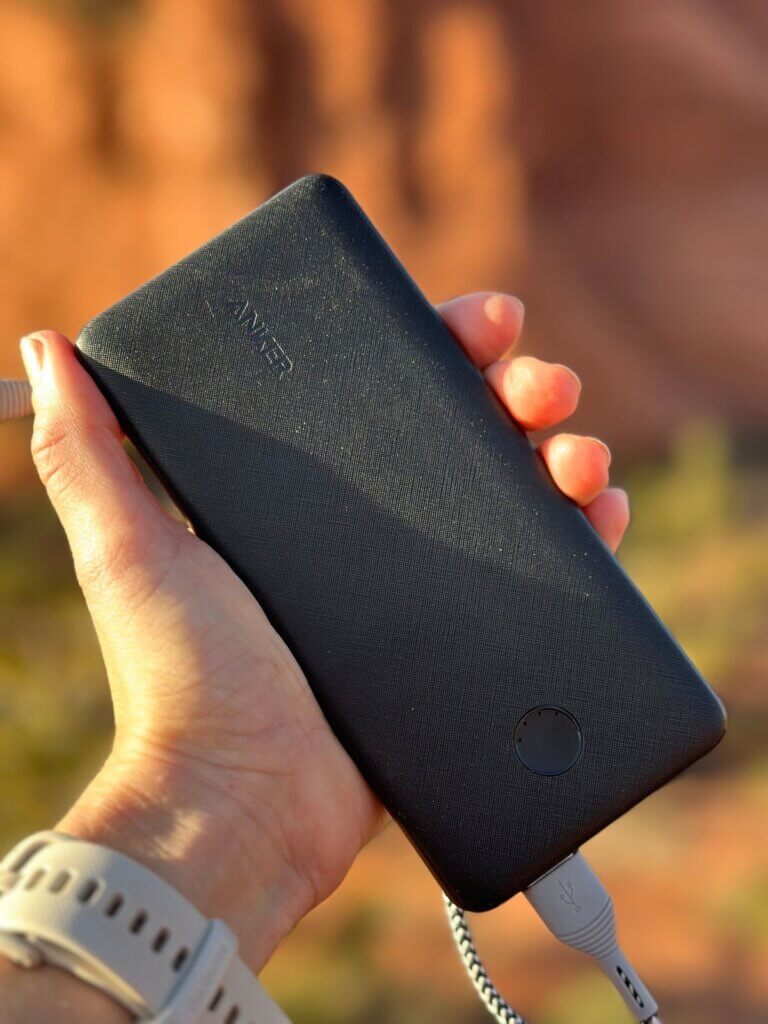
- 10,000 mAh \approx 37\text{ Wh} (Check out our Anker 313 10K review to see how a pocket-sized charger performs)
- 20,000 mAh \approx 74\text{ Wh} (A popular sweet spot; see our tested 20,000mAh power banks with built-in cables for hassle-free travel)
- 26,800 mAh \approx 99.16\text{ Wh} (The standard limit without approval)
- 43,243 mAh \approx 160\text{ Wh} (The absolute maximum limit with approval)


Universal Golden Rules for 2026
Regardless of which airline you book, three non-negotiable rules apply globally under the latest IATA Dangerous Goods Regulations (67th Edition):
- Carry-On Only: Power banks must travel in your hand luggage or on your person. Placing a power bank in checked luggage is strictly illegal.
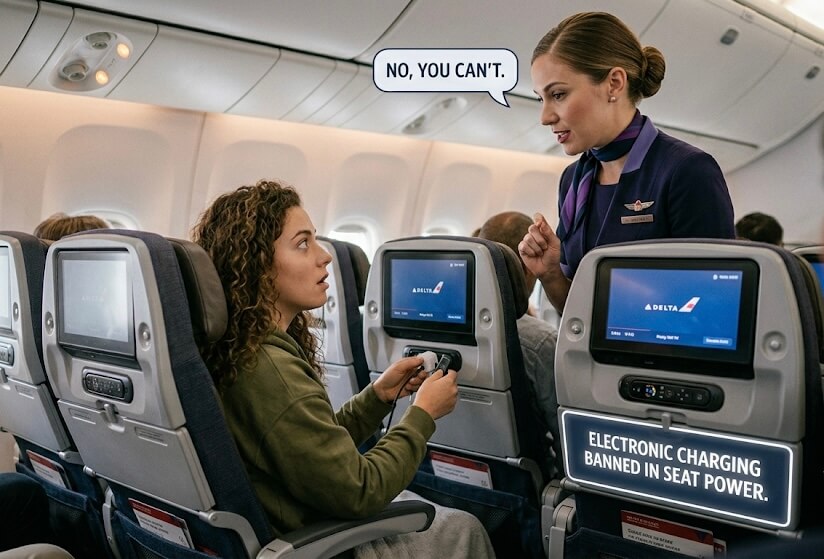
- No Onboard Recharging: You must never charge your power bank using the aircraft’s seat-power or USB outlets.
- Physical Labeling Required: The capacity rating (Wh or mAh with voltage) must be clearly legible on the shell of the device. If the text has worn off, expect airport security to confiscate it.
Pro-tip: If you are a student traveling light on a tight budget, make sure your backup battery fits both your budget and these flight standards by checking out the best budget power bank for students before heading to the terminal.
2026 Airline Power Bank Comparison Matrix
| Airline | Max Wh (No Approval) | Max Wh (With Approval) | Max mAh (Approx.) | Cabin Only? | Checked Allowed? | Onboard Use Allowed? |
|---|---|---|---|---|---|---|
| American Airlines | 100 Wh | 160 Wh | 27,027 to 43,243 | Yes | No | No (Keep visible) |
| Delta Air Lines | 100 Wh | 160 Wh | 27,027 to 43,243 | Yes | No | No (Keep accessible) |
| United Airlines | 100 Wh | 160 Wh | 27,027 to 43,243 | Yes | No | No (Under-seat only) |
| Ryanair | 100 Wh | Prohibited | 27,027 | Yes | No | Yes (Under seat only) |
| EasyJet | 100 Wh | 160 Wh | 27,027 to 43,243 | Yes | No | No (Keep off) |
| Emirates | 100 Wh | Prohibited | 27,027 | Yes | No | No (Strictly banned) |
| Qatar Airways | 100 Wh | Prohibited | 27,027 | Yes | No | Yes (Keep visible) |
| British Airways | 100 Wh | 160 Wh | 27,027 to 43,243 | Yes | No | Yes (Under-seat only) |
| Lufthansa | 100 Wh | 160 Wh | 27,027 to 43,243 | Yes | No | No (Keep off) |
| Turkish Airlines | 100 Wh | 160 Wh | 27,027 to 43,243 | Yes | No | No (Strictly banned) |
| Singapore Airlines | 100 Wh | 160 Wh | 27,027 to 43,243 | Yes | No | No (Strictly banned) |
| Air France | 100 Wh | 160 Wh | 27,027 to 43,243 | Yes | No | No (Keep off) |
| KLM | 100 Wh | 160 Wh | 27,027 to 43,243 | Yes | No | No (Keep off) |
| Etihad Airways | 100 Wh | Prohibited | 27,027 | Yes | No | No (Strictly banned) |
| Wizz Air | 100 Wh | 160 Wh | 27,027 to 43,243 | Yes | No | No (Keep off) |
| ITA Airways | 100 Wh | 160 Wh | 27,027 to 43,243 | Yes | No | No (Keep off) |
Detailed Airline Policies & Requirements

1. American Airlines
American Airlines fully aligns with Federal Aviation Administration (FAA) protocols. However, they enforce a strict capacity count to minimize risk.
- Maximum mAh Allowed: ~27,027 mAh (under 100 Wh) without prior approval; up to ~43,243 mAh (160 Wh) with approval.
- Maximum Wh: 100 Wh automatically; 101–160 Wh with airline approval. Over 160 Wh is forbidden.
- Cabin Baggage Only? Yes.
- Checked Baggage Allowed? No.
- Approval Required? Only for units exceeding 100 Wh (maximum of 2 spare batteries/chargers per passenger).
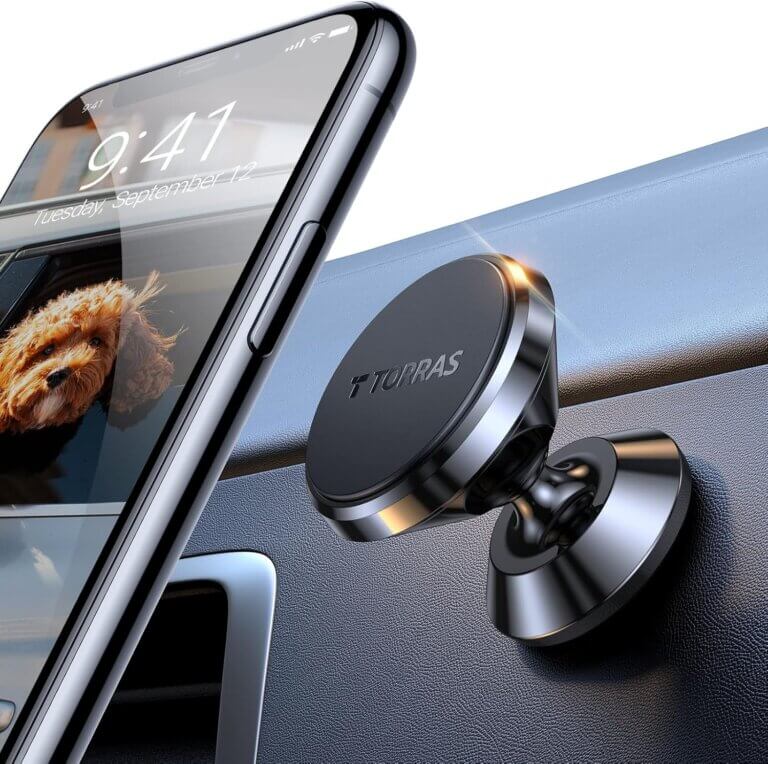
- In-Flight Cabin Rules: Power banks cannot be stored in overhead bins while in use. They must remain visible, on your person, or in a personal item under the seat in front of you. Set your device up on one of the best phone stands of 2026 to watch your movies hands-free while charging.
- Official Policy Link: Explore American Airlines Restricted Items.
2. Delta Air Lines
Delta focuses on keeping spare batteries safe and accessible.
- Maximum mAh Allowed: ~27,027 mAh (100 Wh) standard; ~43,243 mAh (160 Wh) limit.
- Maximum Wh: 100 Wh; up to 160 Wh with authorization.
- Cabin Baggage Only? Yes.
- Checked Baggage Allowed? No.
- Approval Required? Yes, for devices between 101 and 160 Wh.
- In-Flight Cabin Rules: Delta advises storing chargers within reach. Do not store your power bank in the overhead compartment where crew cannot access it quickly in case of an emergency.
- Official Policy Link: Visit Delta Air Lines Restricted Items.
3. United Airlines
Following in-flight incidents, United Airlines implemented specific restrictions regarding where power banks can rest while in the sky.
- Maximum mAh Allowed: ~27,027 mAh (100 Wh) standard; up to ~43,243 mAh (160 Wh) with approval.
- Maximum Wh: 100 Wh; up to 160 Wh with approval.
- Cabin Baggage Only? Yes.
- Checked Baggage Allowed? No.
- Approval Required? Required for 101–160 Wh batteries.
- In-Flight Cabin Rules: United strictly bans storing power banks in overhead bins. Devices must be kept in your seat pocket or under-seat personal baggage.
- Official Policy Link: Check United Airlines Restricted Items.
4. Ryanair
Europe’s largest budget carrier operates a stringent policy on dangerous goods to maintain quick turnarounds.
- Maximum mAh Allowed: ~27,027 mAh (100 Wh).
- Maximum Wh: 100 Wh.
- Cabin Baggage Only? Yes.
- Checked Baggage Allowed? No.
- Approval Required? Ryanair does not allow power banks over 100 Wh.
- In-Flight Cabin Rules: Passengers can carry a maximum of 2 power banks. They must remain under the seat in front of you or in your pocket. No overhead bin storage.
- Official Policy Link: Read Ryanair Permitted Items.
5. EasyJet
EasyJet permits standard consumer electronic chargers but restricts handling methods to ensure cabin safety.
- Maximum mAh Allowed: ~27,027 mAh (100 Wh) standard; up to ~43,243 mAh (160 Wh) with approval.
- Maximum Wh: 100 Wh; up to 160 Wh with approval.
- Cabin Baggage Only? Yes.
- Checked Baggage Allowed? No.
- Approval Required? Yes, for items over 100 Wh up to 160 Wh.
- In-Flight Cabin Rules: Limit of two power banks per traveler. Units must be protected individually from short circuits using a pouch or original packaging.
- Official Policy Link: Read EasyJet Restricted Items.
6. Emirates
Emirates enforces one of the most restrictive in-flight usage bans to eliminate safety risks entirely during long-haul transits.
- Maximum mAh Allowed: ~27,027 mAh (100 Wh).
- Maximum Wh: 100 Wh.
- Cabin Baggage Only? Yes.
- Checked Baggage Allowed? No.
- Approval Required? Power banks over 100 Wh are entirely prohibited.
- In-Flight Cabin Rules: Only one power bank is allowed per passenger. Crucially, using power banks to charge devices on board is completely banned. Keep your charger switched off and stowed under the seat.
- Official Policy Link: Review the Emirates Dangerous Goods Policy.
7. Qatar Airways
Consistently ranked as a world-class carrier, Qatar Airways prioritizes safety while still allowing passenger convenience.
- Maximum mAh Allowed: ~27,027 mAh (100 Wh).
- Maximum Wh: 100 Wh.
- Cabin Baggage Only? Yes.
- Checked Baggage Allowed? No.
- Approval Required? Power banks over 100 Wh are not accepted.
- In-Flight Cabin Rules: You can carry up to 2 power banks. You can use your power bank to charge devices, but you must keep the device in plain view at all times. Do not charge a device inside a bag or an overhead compartment.
- Official Policy Link: Download Qatar Airways Safety Notice.
8. British Airways
British Airways follows the UK Civil Aviation Authority (CAA) frameworks closely.
- Maximum mAh Allowed: ~27,027 mAh (100 Wh) standard; up to ~43,243 mAh (160 Wh) with approval.
- Maximum Wh: 100 Wh; up to 160 Wh with operator approval.
- Cabin Baggage Only? Yes.
- Checked Baggage Allowed? No.
- Approval Required? Yes, for batteries rated 100–160 Wh.
- In-Flight Cabin Rules: Up to 2 power banks are allowed per person. They must be stored in under-seat bags or seat pockets, not in overhead storage. If you plan to settle in with the premium noise cancellation of the Sony WH-1000XM6 vs Bose QuietComfort Ultra, keep your cords secure and your spare batteries stored away.
- Official Policy Link: Visit British Airways Restricted Items.
9. Lufthansa
The German carrier has updated its policy to coordinate safety across all Lufthansa Group regional operations.
- Maximum mAh Allowed: ~27,027 mAh (100 Wh) standard; up to ~43,243 mAh (160 Wh) with approval.
- Maximum Wh: 100 Wh; up to 160 Wh with approval.
- Cabin Baggage Only? Yes.
- Checked Baggage Allowed? No.
- Approval Required? Yes, for 100–160 Wh units (must register via the Lufthansa Service Center).
- In-Flight Cabin Rules: Limit of two power banks per passenger. Onboard usage and charging of power banks are prohibited. Store the unit under the seat in front of you.
- Official Policy Link: Check Lufthansa Electronic Devices Guide.
10. Turkish Airlines
Turkish Airlines closely follows standard International Civil Aviation Organization (ICAO) rules.
- Maximum mAh Allowed: ~27,027 mAh (100 Wh) standard; up to ~43,243 mAh (160 Wh) with approval.
- Maximum Wh: 100 Wh; up to 160 Wh with approval.
- Cabin Baggage Only? Yes.
- Checked Baggage Allowed? No.
- Approval Required? Yes, for capacities between 100 and 160 Wh.
- In-Flight Cabin Rules: Passengers may carry a maximum of 2 power banks. Charging devices with a power bank during the flight is not permitted.
- Official Policy Link: See Turkish Airlines Restrictions Guide.
11. Singapore Airlines
Renowned for strict efficiency, Singapore Airlines requires clear manufacturer documentation for larger power banks.
- Maximum mAh Allowed: ~27,027 mAh (100 Wh) standard; up to ~43,243 mAh (160 Wh) with approval.
- Maximum Wh: 100 Wh; up to 160 Wh with approval.
- Cabin Baggage Only? Yes.
- Checked Baggage Allowed? No.
- Approval Required? Yes, for 100–160 Wh units (requires submitting official certifications/photos).
- In-Flight Cabin Rules: Maximum of 2 power banks per passenger. Onboard usage and charging are strictly banned. Store them under the seat or in the seat-back pocket.
- Official Policy Link: View Singapore Airlines Baggage Restrictions.
12. Air France
Air France operates under identical safety frameworks as its partner KLM to provide a seamless travel experience.
- Maximum mAh Allowed: ~27,027 mAh (100 Wh) standard; up to ~43,243 mAh (160 Wh) with approval.
- Maximum Wh: 100 Wh; up to 160 Wh with approval.
- Cabin Baggage Only? Yes.
- Checked Baggage Allowed? No.
- Approval Required? Yes, for 100–160 Wh batteries.
- In-Flight Cabin Rules: Maximum of 2 power banks. Using or charging them during the flight is prohibited. Ensure they are kept off and stored under the seat.
- Official Policy Link: Search Air France Baggage Information.
13. KLM
KLM keeps its rules clear and logical to safeguard its passengers.
- Maximum mAh Allowed: ~27,027 mAh (100 Wh) standard; up to ~43,243 mAh (160 Wh) with approval.
- Maximum Wh: 100 Wh; up to 160 Wh with approval.
- Cabin Baggage Only? Yes.
- Checked Baggage Allowed? No.
- Approval Required? Yes, for any charger between 101 and 160 Wh.
- In-Flight Cabin Rules: Limit of 2 power banks per passenger. They must not be stored in overhead bins, and using them to charge devices in-flight is forbidden.
- Official Policy Link: Visit KLM Hand Baggage Restrictions.
14. Etihad Airways
Etihad maintains strict safety protocols regarding electronic equipment.
- Maximum mAh Allowed: ~27,027 mAh (100 Wh).
- Maximum Wh: 100 Wh.
- Cabin Baggage Only? Yes.
- Checked Baggage Allowed? No.
- Approval Required? Power banks above 100 Wh are prohibited entirely.
- In-Flight Cabin Rules: Strictly limited to one power bank per passenger. Using the power bank or charging it onboard is completely forbidden. Keep it switched off and stored in your under-seat bag.
- Official Policy Link: Read Etihad Prohibited Items.
15. Wizz Air
This Central European low-cost giant enforces standard cabin safety rules across all of its routes.
- Maximum mAh Allowed: ~27,027 mAh (100 Wh) standard; up to ~43,243 mAh (160 Wh) with approval.
- Maximum Wh: 100 Wh; up to 160 Wh with airline approval.
- Cabin Baggage Only? Yes.
- Checked Baggage Allowed? No.
- Approval Required? Yes, for items exceeding 100 Wh (maximum of 2 larger spares permitted).
- In-Flight Cabin Rules: Power banks cannot be used or charged onboard. They must not be stored in overhead compartments; keep them under the seat in front of you.
- Official Policy Link: Review Wizz Air Restricted Items.
16. ITA Airways
Italy’s flagship carrier aligns completely with EASA standards, requiring passengers to declare larger batteries before departure.
- Maximum mAh Allowed: ~27,027 mAh (100 Wh) standard; up to ~43,243 mAh (160 Wh) with approval.
- Maximum Wh: 100 Wh; up to 160 Wh with approval.
- Cabin Baggage Only? Yes.
- Checked Baggage Allowed? No.
- Approval Required? Yes, for power banks rating 100–160 Wh. Register your device at the booking stage.
- In-Flight Cabin Rules: Limit of 2 power banks. Do not use them onboard, and do not store them in overhead bins. Place them in your under-seat hand luggage.
- Official Policy Link: Review ITA Airways Regulated Items.
Pro-Tips for Smooth Security Screening
Avoiding security lines and gate-side issues is easier than you think if you follow these four simple habits:


1. Protect the Terminals
A short circuit occurs when metal objects (like keys or loose coins) touch your charger’s ports. Prevent this by placing your power bank in its original box, a dedicated protective pouch, or simply applying non-conductive electrical tape over the ports.
Additionally, keeping your connecting cords tidy is just as important. Knowing the physical differences in USB-C vs Lightning cables will prevent you from bringing the wrong wire on board. To guarantee maximum power efficiency when you land, make sure you carry premium, durable fast charging cables.
2. Always Keep Labels Readable
If the rating on the back of your device is rubbed off, faded, or scratched, it might get confiscated. To protect the label, apply a strip of clear tape over the printed specifications when you buy it.
3. Handle Gate Checks Correctly
If your flight is full and the gate agent announces that your carry-on suitcase must be checked, do not panic. Simply open your bag, extract your power banks and other electronics, and carry them with you into the cabin.
Summary Checklist: Before You Fly
- [ ] Does your power bank display its Wh rating clearly?
- [ ] Is your device rated under 100 Wh (~27,000 mAh)?
- [ ] Are your charger’s terminals protected from short-circuiting?
- [ ] Have you packed your power banks in your carry-on luggage?
- [ ] Do you know your airline’s specific limits on how many you can carry?
By following these guidelines, you can ensure a smooth, worry-free travel experience across any of these 16 global airlines. Keep your devices packed correctly, stay updated on individual rules, and enjoy a safe flight!